January 25th sees the annual celebration of Burns Night (and the anniversary of the great Scottish Poet, Robert Burns’ birth in 1759). To celebrate, I thought I would share two of my favourite slings (or brands) from the library.
Firstly, have you seen our Harris Tweed Connecta Baby Carriers. Harris Tweed is woven in the Outer Hebrides and only a select range of companies all allowed by the Harris Tweed Authority to use it and add the famous Harris Tweed label. Wool is naturally breathable and although many think this is a winter fabric it can be surprisingly cool in the spring and summer too.
The other is the Scottish Wrap company – Oscha. I remember when they launched. Many an Oscha wrap has passed through here and one of their classic Roses collection – Roses Dusk – is inspired my my dyed Roses Zen.
This ring sling celebrates its 4th birthday today, as it was dyed to match the bridesmaids dress I wore for my sisters wedding (happy 4th wedding anniversary Becky and Mark).
We have several stunning Oscha ring slings available to hire for that special occasion, including; Vanilla Rose and Roses of the North, as well as Starry Night Orchid.
So let’s support British design, manufacture and business on the Baird’s Birthday.
Although I have been at work today, it has been impossible to miss many of thr headlines. I am, apparently, a pack-horse parent. That is, I “strap my 4 year old to my back” and “don’t let him walk”. Excuse me, but what a lot of old waffle. Unfortunately, this is the myth that the Daily Mail, elements of the BBC and Loose Women have been advocating today. If it were true I would not have as many preschool carriers in the library as I do. Carrying ‘big kids’ is something I have blogged about before and a topic I feel passionately about.
Very few, if anyone, starts out their carrying journey by ‘carrying a 4-year- old’. We start carrying a baby and they grow and we grow in strength with them. They learn that they can come to us for a cuddle and no we won’t turn them away. Our bodies adapt to their changing needs; from front carrying, to hip and back carries, and even tandem carrying.
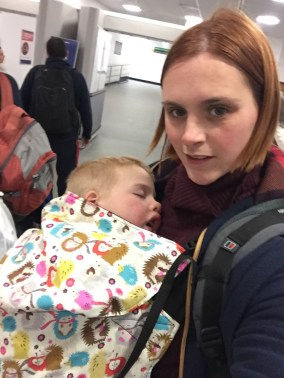
Giving my best ‘pack-horse’ impression after a late night flight.
Toddler and preschool children need, want and seek security, love and warmth as much as small babies. Their mothers and fathers mean safety. Attachment Theory has for the past 70 years taught us that meeting children’s basic need to be love and cared or is not in their best interest. Children who do not have positive or secure attachments suffer developmentally. The strategies we develop to communicate are aversive in their nature – designed to protect us – but without positive reinforcement disappear and stop being used: children can, and will, go into themselves, stop communicating and hide from the world around them.
Children, do not stop needing this support and encouragement just because they can have a conversation and walk. It is not up to the media to tell parents how to parent: that is up to the parent to decide. If that means using a sling or carrier (or even a buggy) to carry their 2,3,4,5 year old, that is up to them. No arguments, no discussion needed. It is their choice. Physiologically it can take the body 90-120 minutes to calm down to normal levels of stress hormones and emotions after they have been upset or frightened. Where else better is there for a child to be when they are trying to regain normal feelings? Even if they appear calm and relaxed there are often hiccups which can pus them back into flight mode.
Although we are “born with legs” those legs do not allow us to walk immediately at birth, it is a skill we need to learn and practise. Like any skill, learning it is tiring and takes time to master. It is therefore natural that sometimes children won’t want to walk yet nobody bats and eyelid if you give child a piggy back. What exactly is the difference? What if those little legs just can’t walk at the speed we need to go at? Do we dawdle at toddler-speed or use devices which can help us reach our targets and goals? In all other elements of life, labour-saving, time-saving devices are praised.
The world is a busy place. How would you feel watching it all from knee-height, unable to fully understand the magnitude of it? Now imagine how exhilarating it would be to see if from the same height as an adult? To talk about what you can see, to ask questions and hear answers, bury your head into Mum’s neck if it gets too much? That is why I carry my children.
Carrying children is normal! Do not let sensationalist headlines and daytime TV tell you otherwise. Do what feels right for your child/children. If it feels right, then it most probably is right. Carry your children for as long as you need and want to, whether that is for days, weeks, months or years. The benefits, far outweigh the disadvantages.
Henry and Isaac have always liked books and words but they are not that keen on reading when they have books sent home. Their school uses the Letters and Sounds phonics scheme to teach reading. I was a little worried about helping them as I didn’t learn phonics but we are getting there.
So what do we do?
1) We have read them bed time stories since they were babies.
Letting them ask questions
Asking them questions about what they have heard
Making predictions about what might happen next
2) We read street and shop signs etc when we are out and about.
3) We ask friends and family members to read with them when they come to visit, rather than it always being me or hubby. They can even read to the dog if necessary. Here is Henry reading to the “dog” during our New Years Eve visit to Seven Stories in Newcastle.
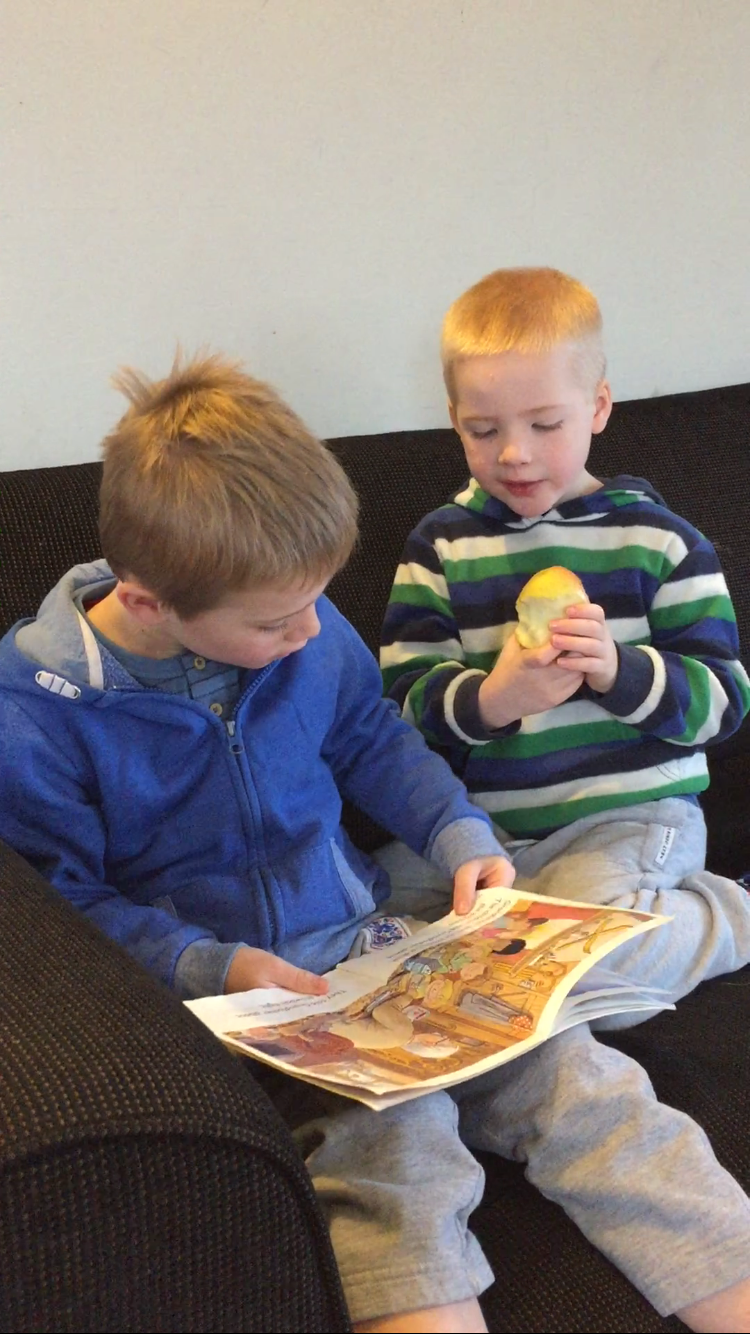
4) I ask the boys to read to each other. This can be their school reading books or a book/magazine of their choice.
Yesterday, in an attempt to encourage two tired boys to read their school book before bed I asked Henry if he would like to go live via my Facebook profile, he jumped at the chance. He seemed to like the fact he was reading to not just me. I then asked Isaac if he wanted to do the same and he did. Technology has its disadvantages but at times like last night it was perfect. During the live broadcast my mum and sister (both who live 160 miles away), and friends from around the country were able to watch, comment and like, giving Henry instant feedback on what he was doing and encouragement to carry on – perfect.
Today I am the mama of a 7 year old. Happy Birthday Henry.
Born 12.31pm on 9th January 2010, 6lb 12oz at 37 weeks + 3, 2.5 hours of labour, and 3 feet of snow and a blizzard. It feels like a lifetime ago but every second is etched in my memory.
Henry you made me a mother, mummy, mama, mum, mam. You taught me to trust my instincts and to do what felt right. I love you with all my heart Henry. You are an amazing little boy and a joy to be around. Your smile, caring nature and zest for life is infectious. Without you, the sling library would not be here.
Happy Birthday my darling boy.
I love walking and have spent many happy hours walking in the Lake District and Weardale with my husband, dog and children. We first took Henry when he was just 4 months old and we have been going ever since but I have never owned a proper carrier. By proper carrier I am referring to a framed back carrier which are commonly seen as a necessary item if you want to do some ‘proper walking’. Well, I think I come in the ‘proper walking’ category: this year we took Henry and Isaac (then aged 6 and 4) to climb Catbells and more impressively Hellvelyn (they successfully summited both). I did take a carrier for Isaac – it stayed in bag the whole time on both days.
Framed carriers are quite bulky pieces of kit and when I first started carrying simply didn’t have the room to store one. They are suitable only for older babies and children (approx. 6 months) who can sit unaided. Visually they look very similar to walking rucksacks, often with thick structured waistbands and heavy padded shoulders. They are readily accessible in many high street shops and outdoor shops with most being priced anywhere upwards of £80 (with some of the most well known being over £100). For many then, they seem the ideal piece of equipment to spend your days walking.
Reasons people like them include:
integrated storage
sun canopies on some
child can “see”
no need to take child out – simply take off and use the ‘feet’ to stand carrier up.
a little more roomy for the child
But, why then have I not felt the need to buy or use one? Firstly, they are bulky. I am used to carrying big backpacks but my spatial awareness is not one of my strong points. The bulk of them means I simply find them too big; especially if I want to traverse small gaps. I do not go on walks alone and thus my husband has been able to carry the necessary ‘baby kit’ in his rucksack. He has even been known to carry Henry on his back and a rucksack on his front.
Why do I need to buy another carrier? Many people who want to use a framed carrier already own a carrier that would work perfectly adequately. Soft Structured carriers are perfect. They fold small, so if you are carrying a slightly older child and they want to walk for a bit you can wear it without it feeling heavy or simply put in your bag, and most have the flexibility of front carrying (some facing out) and even hip carries, where as a framed carrier can only be worn on the back. In a Soft Structured carrier, the baby/child’s weight is also closer to you and this can help with balance and our centre of gravity. Framed carriers can, especially for smaller parents, feel like they are pulling you back and make you feel like you need to lean forward to compensate.
In terms of how baby is positioned in a framed carrier, this can vary from a seat to more of a harness in a frame. This has a big impact on the comfort of the journey for the child. The distance between the wearer and the child is an important factor to consider; especially in cold weather or exposed environments. In most carriers where the baby/toddler’s torso is against the wearers front or back they will benefit from sharing body heat. If the child is too hot, heat transfer to adult occurs to help the child cool down, and if they are too cold, warm up. But this cannot happen when they are not against the adults body. An adult may feel perfectly warm but babies and young children cannot regulate their body temperature as effectively as adults, and thus can get much colder than you would expect.










 I love walking and have spent many happy hours walking in the Lake District and Weardale with my husband, dog and children. We first took Henry when he was just 4 months old and we have
 Framed carriers



 Slings and More