Using a ring sling: where to adjust and how to tighten.

I love ring slings. Whether I am carrying  a small baby or an up and down toddler. But they can take some skill and perseverance to get them right. Small tweaks and tips will help make them so much easier to use.  This blog isn’t going to go into specifics of shoulder styles and fabric as but focus on the technical bits which can be used with any ring sling.

The Rings!

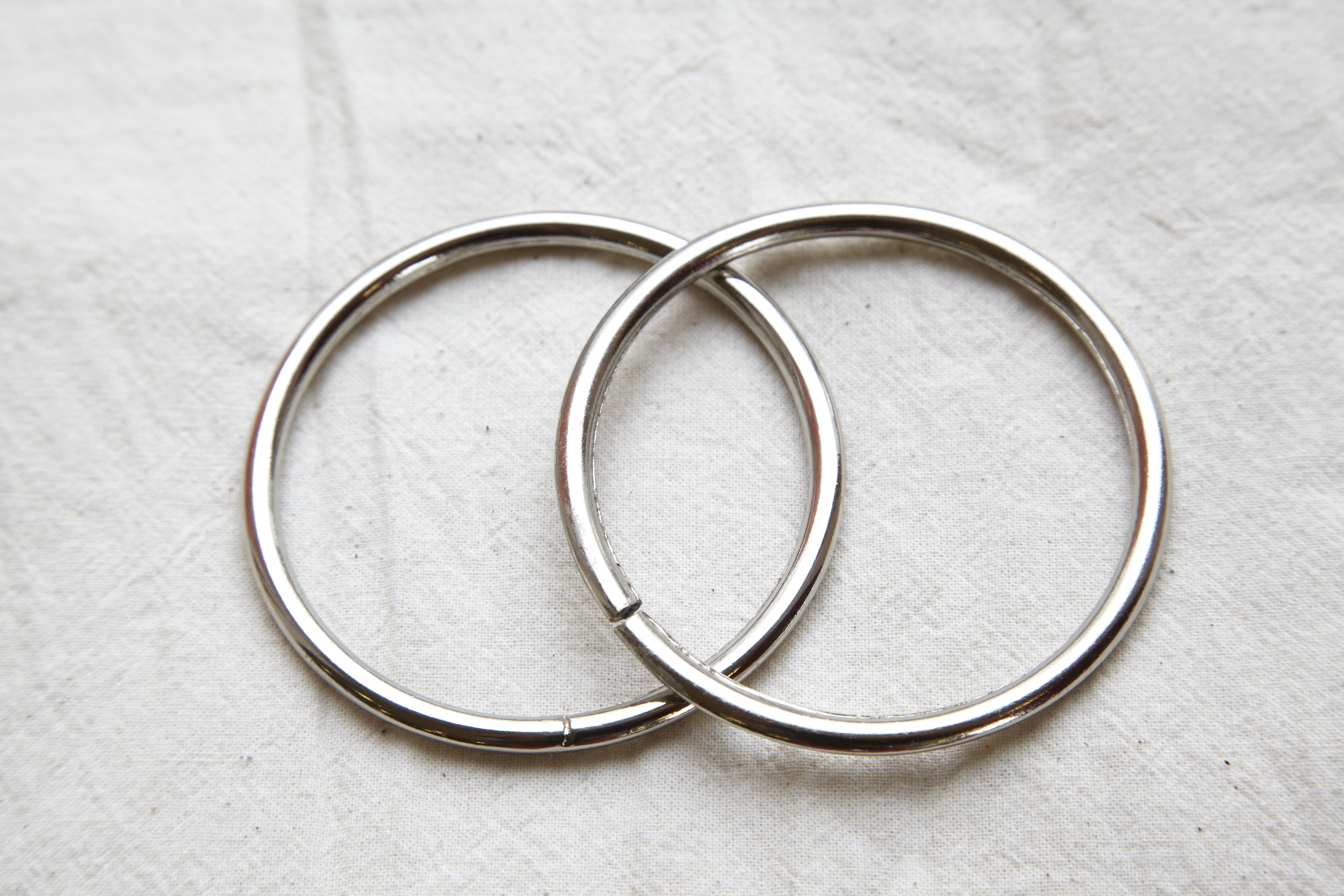
As ring slings are adjusted and locked in place by their rings, it is important to focus on them. They should not be made from welded rings and should be specifically made for this purpose. They can be made from aluminium or nylon. Welded rings can break where they have been joined.

welded rings

Welded rings – can you see the break?

Preparing the sling for baby

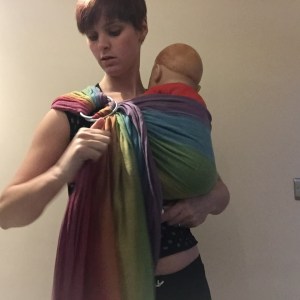
Place the rings on the shoulder opposite the hip you want to carry baby on, or for chest to chest carrying the shoulder you feel most comfortable. Ideally you will switch shoulders each time you carry. The weight of the ring  will help keep them sat on your shoulder. Bring the tail to opposite side. At this point check you are not twisted by holding rings in one hand and top rail in the other before pulling the fabric across your back. It should move only at the top.

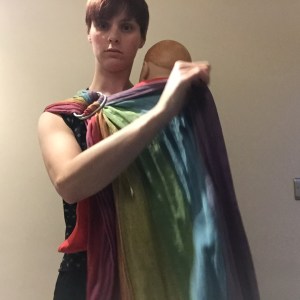
To thread a ring sling you take the tail (unstitched part) and thread it through both rings from the bottom up, before threading back through one. Ensuring you keep fabric neat and untwisted at all stages will help make it easier to tighten.  While you are learning slings with differing colour top and bottom rails will help make this easier too. I personally take the tail up onto my shoulder before threading through second ring so I can see any twists.

     (Photos by NESL)

When you have threaded through both rings take  your thumbs underneath the fabric between rings and spread from middle to rails again ensuring you are not twisted.

With thanks to Rosie @Sheffield Sling Surgery

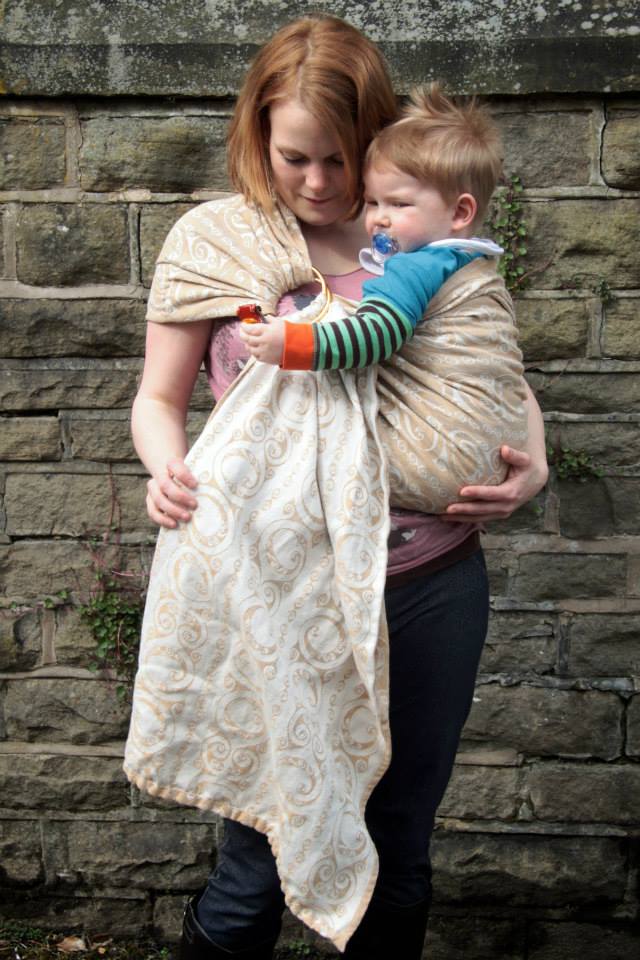
Once threaded the top rail and bottom rails should match and there should be no twists. Loosen the top rail by pulling fabric back through rings to create space to put baby in. Tighten the bottom rail so it is snug against you. The majority of work done tightening the bottom rail should be done before you place baby in, not after.

Putting baby in the sling

Once the preparatory work is completed it is time to put your child in the sling. Do not rush this point. You do not want to undo the hardwork you have done in preparing the sling.

Supporting babies weight with one hand under his bottom, use the other to reach up  from bottom of pouch to find his feet and guide him in.


Let him sit on the unspread pouch before bringing fabric up his back. At this point check where rings have dropped to. If too low lift babies weight and reposition the rings before letting baby sit on unspread pouch again.

With thanks to Wrapamore

Before spreading ensure the fabric is in both knee pits and that babies bottom is lower than their knees.

Keeping on hand on babies bottom bring fabric over their back. For a small baby the top rail should come up to their neck. Tightening a ring sling it is made easier by having the slack brought as close to the rings as possible. Ensure all slack is brought to the rings on both top and bottom rails.


Direction of tightening

Once the ring sling is threaded, baby has been seated in it and the fabric spread over their back it is time to tighten it. The fact the tail hangs towards to floor makes it logical to think you need to tighten by pulling the fabric in this direction, you do not. It is also common for people to take the tail as a rope and pull on it all in one go. Fabric is not a rope and has thousands of individual threads which should be adjusted separately.

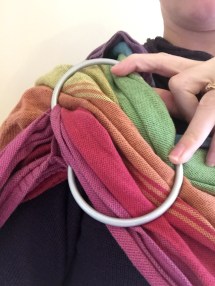
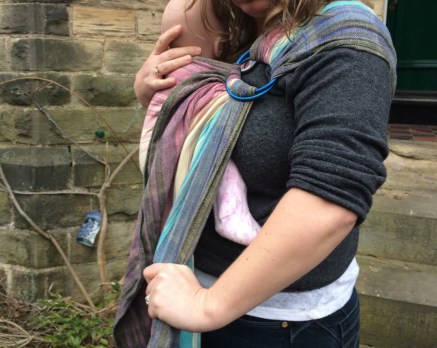
Tightening any sling requires the fabric to be taken to the tightening system. In this case the rings. Then this slack needs to be removed in the direction it came from. The round shape of a sling ring makes can make it difficult for us to think about straight lines and where to adjust.  When working with parents I often talk about how a sling ring is like the sun. Its rays go in straight lines from several points. A sling ring is no different. I have taken a sling ring and drawn straight lines out from several points to illustrate.


You will need to tighten the top, middle and bottom of the ring sling, in fact anywhere there is slack. The most slack is likely to be on top rail where we loosened the pouch to get baby in. The least slack will be on the bottom rail which we had pre-tightened.  When tightening you must lift and support babies weight with one hand to remove the effect of gravity pulling their weight to the floor. By lifting their weight you will find it much easier to tighten. Then adjust the parts of ring sling where there is slack (top, middle, bottom)  by taking it in the direction it came from. You may need to repeat this several times in order to remove all slack.

Support babies weight underneath their bottom

Remove slack working from top rail to bottom but pulling in direction fabric came from

Support the weight of baby at all times with hand, wrist or forearm

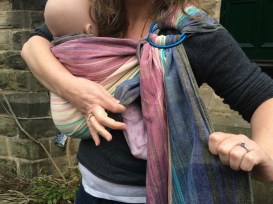
Support baby under their bottom as you tighten. With thanks to Sheffield Sling Surgery - image featuring Kiri of Carry ar Kid

With thanks to Sheffield Sling Surgery – image featuring Kiri of Carry ar Kid

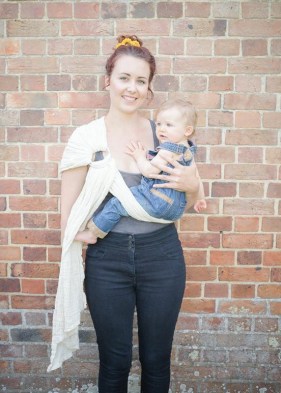
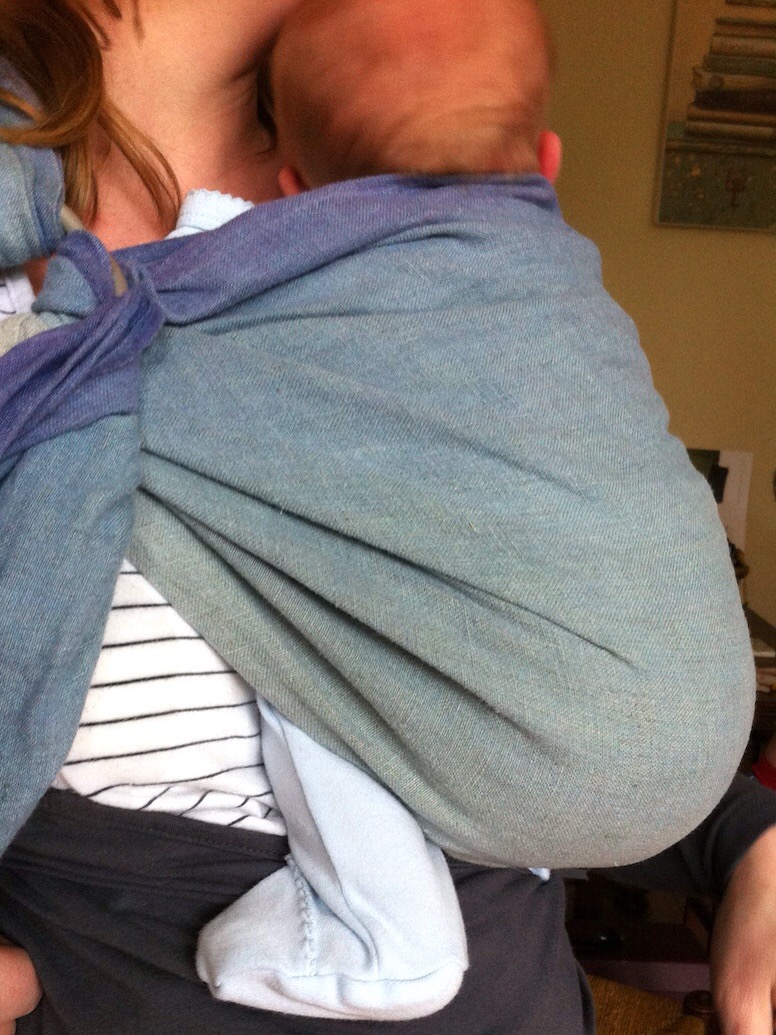
Here you can see the top rail is nice and snug against baby, his natural curves are maintained in a j-shape and fabric is in knee pits. He is in a sitting position with a tilted pelvis and the fabric hammocked between his legs.

This slideshow requires JavaScript.

Slings made me the Mother I am

Today is my 6th Mothers Day as a Mummy. My two beautiful boys are my world. Back in 2010 I was still at the start of my carrying journey and it was my first Mothering Sunday. My baby boy was just 7 weeks old. I was yet to discover the mass array of slings and carriers available. I was muddling through  motherhood the best I could and learning on the job.


Henry at 7 weeks old


Unlike birds our babies cannot sit quietly in a nest. They are not like four legged mammals who can get straight up and walk and run with their mum from birth; they want to be held. They turn their feet towards each other to hold on, they grasp with their tiny hands. Babies are a clinging young. They need us and want us. Slings became my secret weapon to let me meet their needs (and hey mine – it meant I got to eat a meal while it was still hot for example). I didn’t need slings to be a mum but once I did discover them they definitely made me the mum I am. Slings and breastfeeding my babies (both till way over a year) became part of who I am. If they needed soothing because they were tired or upset these became my tools to calm them: Without them I think I would have gone mad. 


I was muddling through motherhood the best I could and learning on the job.

Six years down the line slings are part of me. I have lost count of how many I have owned, holidayed and simply tried but they remain a constant. This week my youngest (2 years 10 months as the prescription form informed me yesterday) had an operation. A relatively minor operation to help his breathing overnight by removing his tonsils and adenoids (he was diagnosed just before Christmas with Obstructive Sleep Apneoa). However, the operation still required a general anaesthetic and a night in hospital. He is still feeling pretty rough five days later. While waiting nil by mouth for his operation he asked for a cuddle in the sling. 


Not the best FWCC I have ever done but post-op if got Isaac settled and back to sleep.


In the recovery room coming around from his anaesthetic he was screaming “Mummy ing” (he struggles with first sounds of words) over and over, back on the ward upset and feeling sore he asked for “ing” before falling asleep. That night when tired but scared because he was in a strange place he was wrapped to go to sleep and when I transferred him to the hospital cot he wrapped himself back up in the wrap using it like a blanket. We have had lots of sling cuddles since we got home. Slings to us both mean security and reassurance. They are also practical for me. He wants to be held but he is 14kg my arms simply won’t let me hold him for the length of time he wants to be held. 

I did not need a sling to be a Mum, I probably could have muddled through without slings but I know they have made my life simpler and less stressful. I cannot imagine the start of my boys lives without them.

Motherhood to me means responding to my boys needs first and foremost; slings (and mummy milk) were my means to do this. Happy Mother’s Day to mummies everywhere. Treasure your babies for they for they don’t stay babies long. But they will always need their mum.

A to Z of Sling Myths Debunked Part 2

After part one of my A to Z of Sling Myths Debunked blog was so well received, as promised here is Part 2 N to Z. Do you have any suggestions for an alternative alphabet of Sling Myths?

New means safe: Buying a sling new does not automatically make it safe. Discrepancies in manufacturing processes, cheap imitations, counterfeited carriers and simple errors in the fabric can make flaws exist in the sling. It is important to check your new sling over when it arrives in the same way you would with a preloved sling. If the price seems too good to be true be careful with your purchase. Cheap imitation and counterfeit carriers do not have any warranty or guarantees. Many new carriers and slings now come with a warranty card which allows you to register your purchase to be notified of any safety recalls. This is primarily associated with slings sold in the USA but it is becoming increasingly more common with UK slings too. Remember to always check for latest instructions for the sling you are using as manufacturers will occasionally change these in accordance with latest safety guidance and best practise. If you bought a sling for older children and intend to use for a new baby take time to double check latest version of instructions from manufacturer.

Overheat: Babies are worn in slings in societies and cultures across the globe. These range from the freezing Arctic north to sub-Saharan Africa so the issue of temperature control is an important one. Your baby is not going to overheat in a sling and there are some simple measures you can follow to ensure you both stay as comfortable as possible. Firstly ensure you both stay hydrated. Breastfed babies are likely to want to feed more frequently in hot weather, therefore keeping Mum hydrated is very important to maintain milk supply. If your baby is bottle fed ensure you offer liquids regularly. Clothing is an important factor to consider too. Layers provide an excellent way of keeping warm in cold weather and in hot weather fewer layers is key. Remember, the sling you are using can often be counted as several layers of clothing. Could you opt for a breathable fabric or lightweight sling? Finally make sure exposed skin is protected from sun and wind burn. Did you know that if you wear your baby skin to skin that it is possible for thermoregulation to occur. This is perfect if your baby has a temperature and is feeling poorly.

IMG_1544

Premature babies need a stretchy wrap: Stretchy wraps are often a parents first introduction to slings and are often suggested as ideal for parents of premature babies. Kangaroo Mother Care has been identified as helping premature babies to develop and grow and one element of this is skin to skin contact. Skin to skin can be facilitated by a wrap, whether stretchy or woven and in fact does not require a sling at all. Many stretchy wraps are suitable for very small babies (Hana Baby, Boba Wrap, Victoriaslinglady for example) and there are an increasing number of Kangaroo Mother Care tops available. However, although relatively simple to use there are occasions when a stretchy wrap would not be suitable for a premature baby. Those born with low muscle tone for example may benefit from the support of a woven wrap for example. Therefore it should not be a blanket ‘premature babies need a stretchy’ but more ‘contact a sling consultant for advice on your specific circumstances’.

Quit (don’t): The two most common reasons I find why people want to give up are 1) They are finding it tricky and 2) something is uncomfortable or hurts. For the first, the easiest way of getting better is by practise and asking for help. Once you have mastered the basics it does get easier. The second reason is more tricky. People often assume that if it hurts then you need to quit. Although this may be the case, it may also be your body getting used to a new form of exercise. If you have never carried your baby in a sling before don’t expect to be able to have the stamina to carry them straight away for hours at a time. If you have only ever front carried then your body will need to readjust if you start back carries. Like with any exercise the more you do it, the easier it becomes. Consider a different sling; more or less padding, rucksack or crossed straps. Again ask for help and someone can work with you to find a solution. It is important though never to ignore your doctors advice if they tell you to stop carrying and do not expect a babywearing consultant to just carry on; that would mean we were giving medical advice something we simply aren’t qualified to do. Could another adult carry baby? Or have you considered taking your sling to show your doctor and let them see it in use before making a blanket ban?

Ruin your back: “You must have a back of steel” or “oh I couldn’t do that with my back” are phrases I have heard a lot. However, no one ever says it to parents who are using a buggy, yet in 2009 83% of mums surveyed for a survey for pushchair manufacturer Maclaren admitted to back pain caused by using a buggy. By carrying baby it also eliminates the need to keep bending down and picking them up. Using a sling could also be more forgiving on your body than trying to carry a cumbersome infant car seat.

Support: It is quite a common myth that you need slings, especially with woven wraps that you need them to be made from blends to be supportive. Firstly, you could have the most “supportive wrap” in the world but it will not be supportive or comfortable if you haven’t tightened it fully as it will leave slack in the carry. For example in a Front Wrap Cross Carry the passes are not needed to be spread for the carry to be classed as a FWCC and if tightened the passes are not needed. They may be useful for warmth or to provide a little head support for a sleeping babe, but if needed to stop it feeling like they are pulling away from you then there is slack that needs removing. Secondly, the term ‘supportive’ is often confused with comfortable and not being diggy on shoulders. Twisting rucksack shoulders for example can be painful. Have you considered sandwiching shoulders or trying a ruckless carry. A 100% cotton wrap is tested to be able to carry much heavier weights than the baby or toddler that will be carried in it. If needed it could carry an adult. If it was truly unsupportive it would break. The terminology which we use is important.

IMG_1552

Toddlers: The trend for toddler size carriers is an extremely new phenomenon and do you know something? Toddlers do not need a toddler carrier. The issue here again is terminology and often people wanting to ‘get the best value for money’. We tend to refer to a baby as a toddler once they start, well toddling. But babies all start toddling at different ages. My own children started walking at 16 months, my godson 9 months for example. The trend for toddler size carriers has come with the emphasis put on a carrier being knee to knee but as we discussed in A to Z of Sling Myths Part One Knee to Knee is not as important once a baby can bear weight and thus once they have started to walk. Issues of body height and width of the toddler carriers can have a massive impact on your toddler. Is the panel so high that they are no longer visible? Do they like arms out and now can’t do so? Have they had to widen their legs more than they are comfortable with because of width of the carrier? These are all as important as whether the carrier is still knee to knee. Buying a carrier that is simply just too big for your child isn’t value for money but a waste of money while you sit waiting for them to grow into it. Remember most slings hold their value so if you buy one and then need to sell it on to help fund your next carrier that is ok. Most carriers have been tested to huge weight limits so they are not going to break under the weight of your toddler and finally, once a toddler starts toddling they will often want to practise this skill. Your carrying time will often reduce and your carrying needs may change as they want to be up and down a lot. Having a sling which simply fits in your change bag for that ‘up’ moment may be preferable.

IMG_1221

Universal: One size does not fit all when it comes to slings. Every individual baby and adult that comes through my door has an individual carrying need. The vast array of slings on the market (at last count my library had 212) shows that one carrier will not suit everyone. What works for your friend may not work for you and your baby. Our body shapes are different, we have different preferences for shoulder styles, levels of padding, direction of tightening for example. There are ‘fashionable’ carriers available but just with clothing, fashions change. Don’t just assume because it works for your neighbour/friend/partner/a person on the internet it will work for you. Visit your local sling library or baby consultant. If you don’t have one near you hire one from those that do postal hire and try a few until you find the one for you and your baby now.

Vast amounts of fabric: It can be quite daunting when someone unfolds 5m of fabric. However, it is often halved very quickly once wrapped around you once, for example with a Front Wrap Cross Carry. The part of the sling where baby sits is quite small and the tails are used to tie. Pre-tying a sling can help reduce the need to tackle the fabric while out and about. There are also different lengths of wraps available, so spending time finding a wrap suited to your size and build can help. The more you practise the less fabric you will need to use too, so be careful not to buy a wrap that is too long.

Wrapping is complicated: Learning to use a sling is a skill. Learning to wrap is no different to any skill we have needed to learn. All wrap carries are made up of the same limited number of passes. It is learning these individual passes which will help you learn to wrap, as once you know the individual passes it is possible to do any carry. They will take practise, but any skill worth learning takes time to master. Don’t worry if your wrap job isn’t perfect. Perfect wrap jobs are few and far between and often found in instruction manuals only. If you feel like giving up after the first few attempts at wrapping, remember how difficult you found installing the carseat or folding the pushchair the first few times you did it. After a bit of practice, they become second nature and muscle memory takes over. Soon it will be second nature.

Xtras: A common concern by people using a sling is how do you carry all the ‘xtra’ stuff you need to take with baby and they assume it is not possible. The first thing to consider is are you front or back carrying? If front carrying a rucksack works well as it sits on your shoulders. There are special bags available on the market too. Any bag with a long messenger style strap work if you can get it to go over you and baby. I personally just use a large handbag as it is designed to sit on my shoulders so I rest if on top of the sling I am using. It is also worth considering do you need everything you have in your bag? I have been known on one night out to shove a nappy in one pocket, wipes in another and my phone, purse and keys in another. For longer day trips shopping trolleys can be filled to the brim and pulled behind you.

Y pull: If you look at lots of YouTube videos and even some instructions you will see them demonstrating a Y pull (or L pull) to tighten their sling. Both a Y pull and L pull provide a generic all over method of tightening a sling when you treat the sling like a rope holding full width of fabric in each hand. They are most frequently seen used when wrapping. However, woven wraps are made from hundreds of individual threads which all act independently of each other. It is therefore preferable to tighten each thread by using a strand by strand tightening method to remove the slack. By using a strand by strand tightening method you also avoid putting extra pressure on baby’s spine by over tightening and focus exactly on where needs tightening.

IMG_2105
Zzzzzzzz: We all want our babies to sleep well. Society has told us that we should separate our baby from us and encourage them to self soothe. Unfortunately babies do not always want to be put down. How many of us have got a baby to sleep at the breast, bottle or in our arms, only for them to wake the instant we put them in their cot or Moses basket (Oakwell-Smith). The calming impact of your breathing and heartbeat has gone, the warmth of your body isn’t there. It’s normal behaviour. Using a sling lets baby have their daytime rest with you, it lets them feel secure. Use of skin to skin contact has been shown to help baby fall asleep quicker and lead to longer periods of more restful sleep (Ferber et al 2004), using a sling can facilitate this. One study found an 86% decrease in quiet sleep when infants were removed from their mothers for sleep (Morgan et all 2011). Using a sling can make daytime naps easier, simply as you don’t have to be set to strict routines at home, baby can nap while you shop, walk dog etc. The ‘Back to sleep’ has seen a reduction in SIDS deaths but the majority of deaths still occur when baby is in a room by themselves (Blair et al 2006). By carrying them for their sleep you can stay alert to their breathing and spot signs of distress early. Remember always keep them visible in the sling. You can read more about baby slings and sleep on the ISIS online website.
Continue reading

A to Z of Sling Myths Debunked Part 1

We have all heard friends, family, colleagues and even random strangers say things about using a sling or carrier which simply is not true. These myths exist usually because of lack of knowledge. This is going to attempt to be the A to Z of Sling Myths debunked. There is a mix of serious and more light-hearted ones. The term ‘sling’ will be used to refer to every type of carrier for purposes of ease. But whichever category they belong to there are 26 myths which need debunking. So let’s start with Part 1: A to M.


All the slings : It is quite common to visit sling boards and be inundated with stash shots from people who have lots of slings. You could easily believe that you are only a ‘true babywearer’ if you have a huge stash slings all neatly folded and stored. This is simply not true. Throughout life people collect different thing and you can be collector of slings if you wish. But equally valid is having one sling that meets you and your baby’s needs. It doesn’t matter if you have one or one hundred; all that matters is you are keeping your baby close.

IMG_1372

Back carrying: There is no best before date on back carrying. If you don’t want or need to do it then you do not need to. It does not make you any less of a sling mummy or daddy than someone who back carries from day 1. It is personal preference. If you choose to start don’t worry if you give up the first few times. Make it a game and practice simply getting your baby on and off your back to begin with. When you do start make sure you and your baby are comfortable, and have a spotter or a soft mattress available.

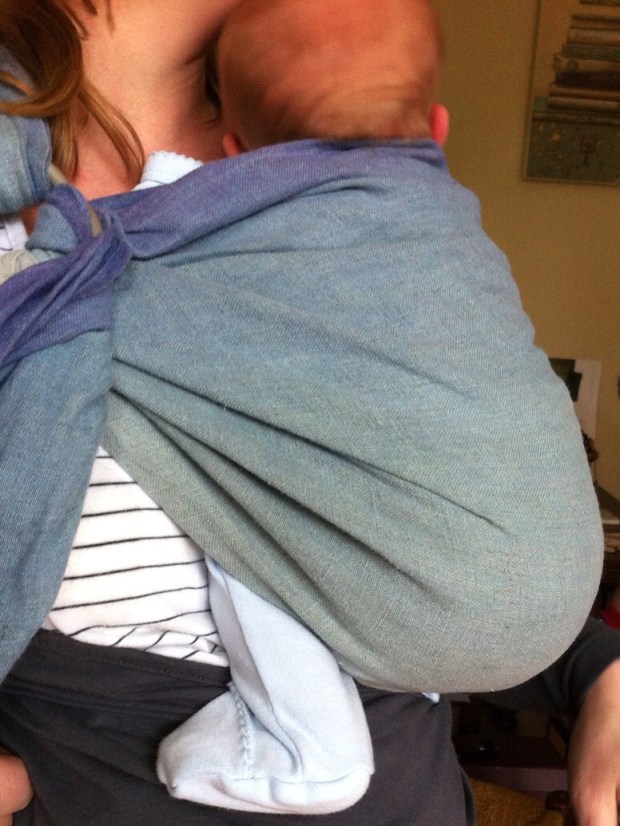
C Shaped Spine: The spine is not straight but it takes around a year for babies spines to take on the s-shape associated with an adult spine. At birth, babies are in curled up, with their spine in a natural long gentle curve. As the muscles in baby’s neck get stronger, they begin to lift his heavy head, and a curve starts to develop in his neck (the cervical curve). When your baby starts crawl the lumbar curve (lower back) develops. People will often refer to the curled up state of a newborns spine as a C-shape. However, we all write the letter C in different ways and it can be extremely curled up. A curled up position can cause baby’s chin to touch their chest and this holds risks of positional asphyxia. Ideally we should discuss a j-shaped spine where babies head is supported to prevent chin on chest but where lower spine is curved.
IMG_2073

IMG_1836

http://www.babyslingsafety.co.uk British Consortium of Sling Retailers and Manufacturers 2010

Dangerous: There are dangers throughout life and using a sling is not inherently dangerous. However, like any form of equipment if you do not know what you are doing, or do not follow the instructions there is the potential for harm. The group of babies most at risk are newborn (with increased risk for low birth weight or premature) babies. To minimise risks to baby it is important to follow the TICKS guidelines (Tight, Inview, Close enough to kiss, Keep chin off chest, Supported back). Ensuring your baby is visible at all times and that there airway is kept clear will help reduce risks. This super article by Dr Rosie Knowles of Sheffield Sling Surgery is an excellent resource for what you need to consider when carrying a newborn in a sling.

Expensive: This myth I read a lot and probably is also associated with ‘Alltheslings’. Using a sling can be as cheap or as expensive as you want to make it. If you want to buy a handwoven or limited edition sling it will cost you. However, there are numerous budget makes available. Woven wraps can be purchased new for around £40-£50 from companies such as Little Frog or Lenny Lamb. This price is comparable to umbrella fold strollers for example, but unlike these wraps tend to hold their value. When buying a handwoven or handmade carrier you are buying someone’s time and skills not just the sling. You don’t however need to own a Limited Edition (where market economics mean price will often go up) or a handwoven/ handmade sling if you cannot afford it. Making your own Simple Piece of Cloth sling is often suggested but when quality fabrics cost approx. £10/metre you are not really getting a sling cheaper. The sling designed and manufactured to be used as a sling will often be more comfortable than the sling fashioned from general use fabric.

Forward Facing Out (FFO): Is not dangerous to your baby. Contrary to popular here say there is no evidence that carrying your baby forward facing out or in a high street carrier is harmful for either baby or adult. Using them cannot cause hip dysplasia, although it can increase risks for those with condition. High street carriers and the FFO position are primarily a concern because they are not always supportive for baby or wearer. There are time limits on this positon although these are regularly ignored. There are there for both of your comfort. Babies should never be left to sleep FFO as in this positon, and if carrier not adjusted correctly for baby’s chin to touch their chest. You can read more about Forward Facing Out here http://blog.norwichslinglibrary.co.uk/a-bad-reputation-deserved/.

Getting too heavy: Surely once they start walking you stop carrying them? Are they not too heavy to carry? These are phrases I hear a lot. My point is that you do not just stop using a pushchair once your little one starts to walk, so why stop carrying? If you would push them or carry them in arms then it is perfectly acceptable and possible to carry them in a sling. For most parents who have carried their children from birth they do not notice their child getting heavier as the adults body adapts to the weight, like it would with any exercise. There is a vast array of sling on the market and many have been safety tested to high amounts. Little legs, even walking legs, tire quickly and having a sling in your bag is a lot more convenient than taking a pushchair just in case you need it.

IMG_2074

Help is required: It is often assumed that using a sling, especially a wrap or back carrying, will require two people. This is simply not the case and could actually be more dangerous than one person doing it by themselves. The reason being the person in charge of the sling knows what they are doing, they know what their next movement is going to be, where the pass or strap is going to go, they know where their baby is. A second person is either guessing what you are going to do or reliant on your instructions, and in some cases going to do their own thing. Who is in control of sling and more importantly baby now? If you need 2 people then you are doing something incorrectly.

Independent: Using a sling or carrier will not make your child clingy. Maslow’s ‘Hiearachy of Needs’ places security as a primary need for development, and this need must be met for a child to grow and thrive. By using a sling you are allowing your child to develop strong attachments to a care giver which will allow them to have the confidence to explore the world alone in long run. Attachment Theory explains how human beings respond within relationships when hurt, separated from loved ones, or perceiving a threat (Waters et al 2005). At the start of their lives babies will have the strongest attachments to those they are closest to, usually the mother, and those with strong attachments will explore more easily than those that don’t (Schacter et al 2009). Therefore do not fear creating a rod for you own back by attending to and following your child’s needs; that is simply not how their brains are designed to function.

Just a minute: We have all seen it. The video of the lady wrapping with a stretchy in super quick time (less than a minute). The problem is if you listen carefully there are voices in the background which give you a clue. It’s been filmed on time lapse. Yes it makes it look easy and quick. And yes wrapping a stretchy can be  quick but it takes practice. What the video doesn’t show is whether wrap is a one or two way stretch or the key elements of tightening a stretchy to make it safe and comfortable on both baby and wearer. Take time to learn how to tie and ask for help from someone trained if you need it. Don’t worry if you don’t wrap quickly at the start. The more you do it, the quicker you will become.

Knee to Knee: The theory behind Knee to Knee is that you can create a more comfortable carry for baby by supporting their legs from their knee pit to knee pit. The proponents of Knee to Knee often suggest that you need a new carrier when your child is not supported in their knee pits but the life span by which a carrier is truly knee to knee is relatively short, and this could cause you to be regularly changing your carrier unnecessarily. Knee to knee is an issue of comfort not safety and a carrier does not become uncomfortable overnight. There are lots of other issues which should be considered when thinking of buying a new carrier. A carrier that is supporting a baby Knee to Knee is helping to support their hip joint and healthy hip development, but for babies that are able to bear their own weight and walking, the process by which their hips have turned to born is complete and any potential there was in casing in harm is removed. Why not have a read of Beyond the Knee to Knee see what other issues need to be considered.

Lifestyle: There is no one type of parent who uses a sling. Although they are often associated with Attachment Parenting you do not need to be an Attachment Parent to use a sling. Many followers of AP for example do not use or a sling, while others use a mixture of sling, walk or pram. As parents we do what makes life easier for us and our children. Using a sling can be a temporary choice for a special occasion, a day trip where it the pushchair is unsuitable, or because baby is ill and wants extra cuddles. It can also be because it makes your life easier to look after other children or go about daily routines. Anyone can use a sling if they feel they want to, it does not mean you follow a set lifestyle or parenting philosophy.

Modern Invention: I have lost count of how many times I have heard “oh that’s clever, did you invent it yourself?” The truth is that for as long as humans and our predecessors have needed to move, our offspring have needed to be carried. This is why a newborn baby will turn their feet towards each other and why they have a grasping reflex; it was to hold on. Humans are clinging young. We cannot run with our parents from birth, do not have pouches where we can be kept safe, or live in nests quiet and out of sight of predators, we needed to cling to our parents to be kept safe. The modern invention is the pram, only becoming fashionable in the 1800s during Queen Victoria’s reign. Each culture around the world has their own tradition of carrying and style of sling or carrying aid. You can read more about the different histories of sling use around the world in the beautiful book “Beloved Burden” or at Sling Babies.

Come back soon to read Part 2 A to Z of Sling Myths Debunked – N to Z.


References

Waters, E., Corcoran, D. & Anafarta, M. (2005) ‘Attachment, Other Relationships, and the Theory that All Good Things Go Together’ Human Development 48:80–84

Schacter, D.L. et al. (2009). Psychology, Second Edition. New York: Worth Publishers. pp.441

Should we stop using the term ‘babywearing’?

I am extremely lucky. I have had two pregnancies and I have two babies. I know other are not so blessed. My boys are my world and even though they are 5 and 2 they will forever be my babies. I have carried them through pregnancy, in my arms and in a variety of slings and carriers. I have also used the term “babywearing” a lot but now I am thinking; should we really use it?
image

The term Babywearing was first used by Dr Sears and is one of his 7B’s of Attachment Parenting. I never thought I would be an AP parent and until Henry was about 4 months old I had never heard of it or Dr Sears, let alone babywearing. As I come through the trials of new parenthood and we are now in the “big boy” categories of preschool and school age I looked back at how I choose to parent and I did what was natural and seemingly unconsciously based my parenting on what understanding of child development and psychology I learnt during my degree. Using a sling was just a) practical and b) what seemed like the best way of keeping my little one close while I carried on. I did not start carrying Henry because I wanted to be seen to be an AP parent, because I was a hippy or want to carry some form of fashion accessory.
image

Yet my website states I am a babywearing consultant; by using it am I somehow making light of what I do? Or why we carry our babies? Does it create an us and them barrier? Does it make people think I won’t help them with their high street carrier? Does it make assumptions that I want everyone to use wraps? Does it make people think if they do x, y or z that I won’t help them? These questions bother me but it’s a term that is becoming more widely known and recognised. Do I stop using it because it upsets some groups and individuals or do I carry on, after all my babies will always be my babies? Or should we use something different? Baby carrying? Am I simply a Carrying Consultant?
image

Finding an answer to these questions is not going to be easy. While I know some organisations refuse to use the term babywearing I am not sure where I sit. But life is not black and white. As an industry we may never find a solution either. So in the meantime I might just plod in as I am.